
Ness County Scheduled and Actual Release
A projected or calculated date is a planning milestone based on the sentence and information then known. An actual release date records the event after custody ends or passes to another holder. Kansas records can also refer to parole eligibility, conditional release, a maximum date, or final discharge. Those phrases are not interchangeable. Each comes from a different part of the sentence or release process.
Timing is also system-specific. A Ness County Jail discharge can return a person to the community, but a transfer to KDOC, another county, federal authorities, or ICE means local custody ended while government custody continued. The receiving agency must confirm the next stage. A court order can authorize release yet still precede jail processing or another hold.
Pretrial detention works differently. There is no sentence from which to subtract credits. Bond, dismissal, later court action, unrelated holds, and administrative processing determine whether and when the person leaves. For a local sentenced term, the sentencing order, jail credit, and Sheriff’s record are essential because Ness County publishes no online jail-release calculator.
Find a Ness County Projected Release
Start by classifying the case as pretrial, locally sentenced, or KDOC sentenced. The route changes with that answer. KASPER applies to KDOC-operated or funded programs. It is not a complete record of all Ness County bookings, so a person who bonded out after a short jail stay may have no state result.
- Read the court case. Use the Kansas public court portal to locate the Ness County sentence, jail credit, later modification, and any commitment to KDOC.
- Identify the holder. Ask the Ness County Sheriff whether the person remains locally held or was transferred. Use KASPER only for a KDOC-linked case.
- Search the state record. Open KASPER, prefer the KDOC number, and otherwise compare name, alias, date of birth, conviction county, and other identifiers.
- Copy the exact label. Record the full status and each date exactly as the live detail page presents them. Do not rename a conditional or maximum date as a projected date.
- Ask what affects it. Contact KDOC for a state calculation. For a local term, ask the Sheriff and court about the order, jail credit, and holds.
- Confirm after the event. Check the custodian’s current status and request the actual release or transfer record.
The Ness County release search guide explains the broader record path when the need is to prove a past departure, not estimate a future one. The jail’s actual release time and the court’s legal action may differ.
Ness County KASPER Date Labels
KASPER stands for Kansas Adult Supervised Population Electronic Repository. Its public form offers first, middle, and last name fields, alias searching, KDOC number, photograph choices, and advanced descriptors. Those controls include KBI number, race, gender, birth date, age range, conviction county, and parole county. The SSN control is a yes-or-no search response, not public display of a Social Security number.
The official KASPER entry and disclaimer is the starting point for a state sentence.
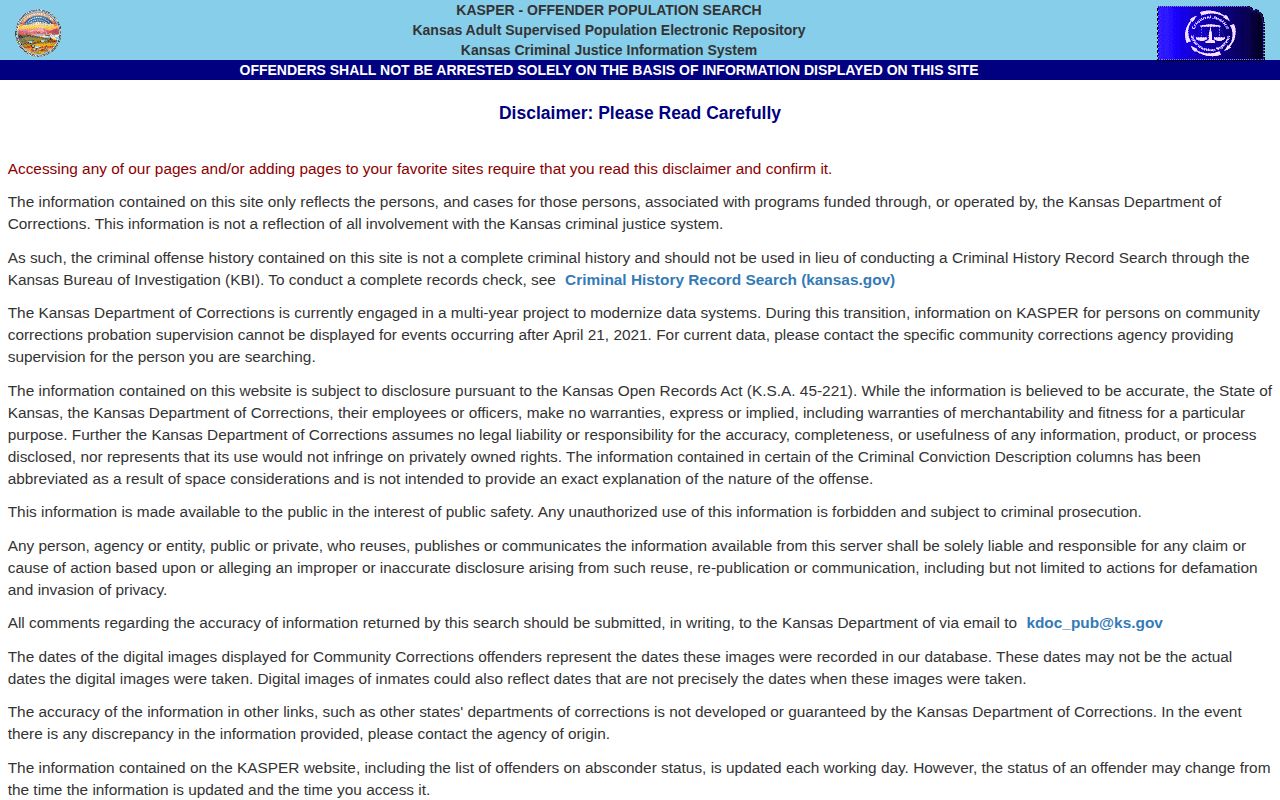
The research capture did not produce a suitable released-person detail through the site’s reCAPTCHA. For that reason, no claim should say every KASPER result literally displays “Projected Release Date.” Open the full detail and transcribe the current label, which may concern release, conditional release, maximum date, or discharge. Then ask KDOC what that label means for the specific sentence.
KASPER updates information on working days, and a status can change between updates. It is not a full criminal-history system. Community-corrections events after April 21, 2021 may also be absent during data modernization. A missing state result does not settle a Ness County jail question.
Note: Save the label, displayed status, agency, and access date, rather than copying only a bare calendar date.
Ness County Kansas Good-Time Rules
Kansas release calculations depend on offense date, sentence type, severity, credits, and parole law. K.S.A. 21-6821 authorizes KDOC good-time rules, along with credit forfeiture, for guideline-era sentences. For crimes committed on or after July 1, 1993, the general maximum good-time amount is 15 percent of the prison portion. That cap is the source of the common 85-percent shorthand.
The shorthand is not a universal Kansas rule. The statute provides a 20-percent cap for specified lower-severity nondrug offenses and specified drug offenses in applicable date ranges. Program credits have their own provisions and limits. The applicable category must come from the actual offense, date, and sentence record, not a guess based on term length.
The official good-time statute shows the categories and credit limits that can affect a KDOC date.
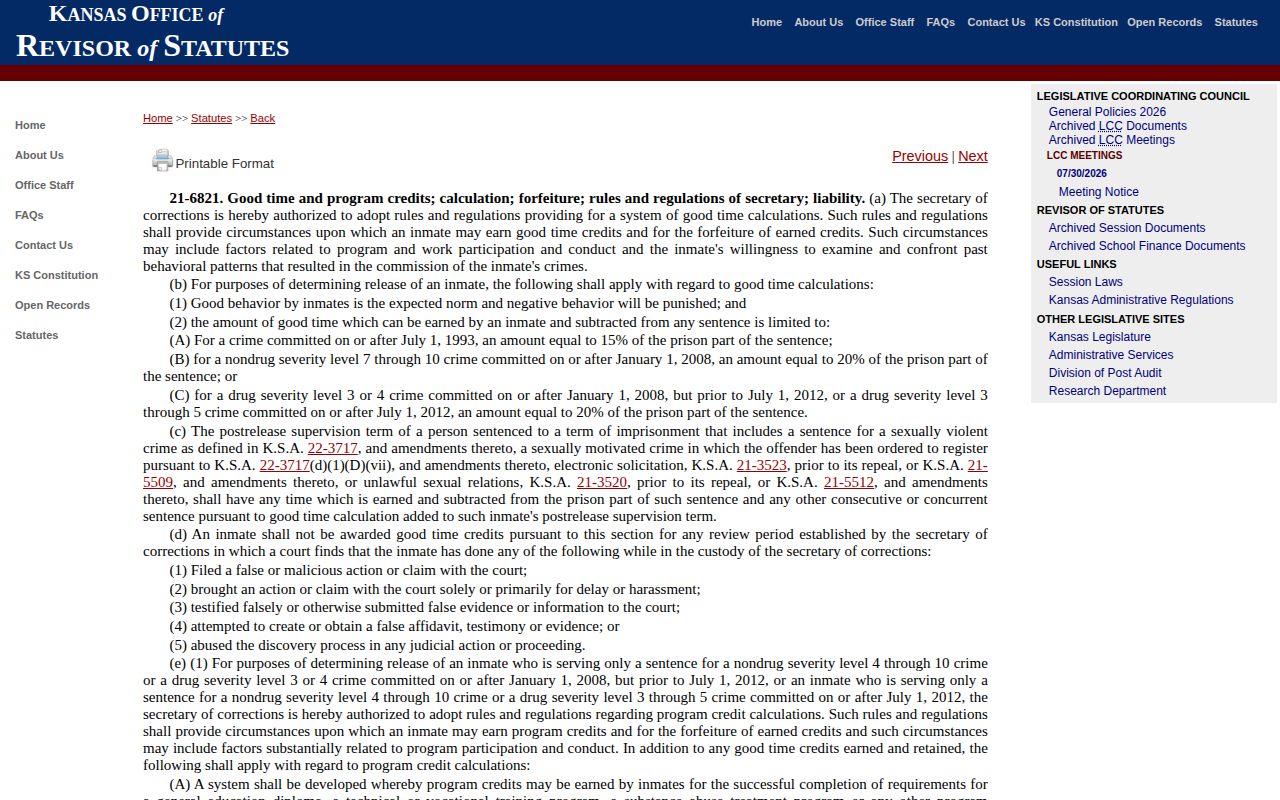
Credits may be earned, forfeited, or limited. KDOC applies those rules to a state prison sentence. Do not apply KDOC percentages to a local Ness County Jail term. No official Ness County jail good-time policy or public calculator was found. For a local term, use the court’s sentencing order and jail-credit entries, then ask the Sheriff how the authorized date is being calculated.
Ness County Older Sentence Calculations
Older Kansas cases use a separate framework. K.S.A. 22-3725 addresses good-time calculations for specified crimes before July 1, 1993 and expressly says it does not apply to crimes committed on or after that date. Indeterminate terms may also interact with parole and conditional-release law.
The pre-1993 statute is a distinct source for an older Ness-connected state sentence.
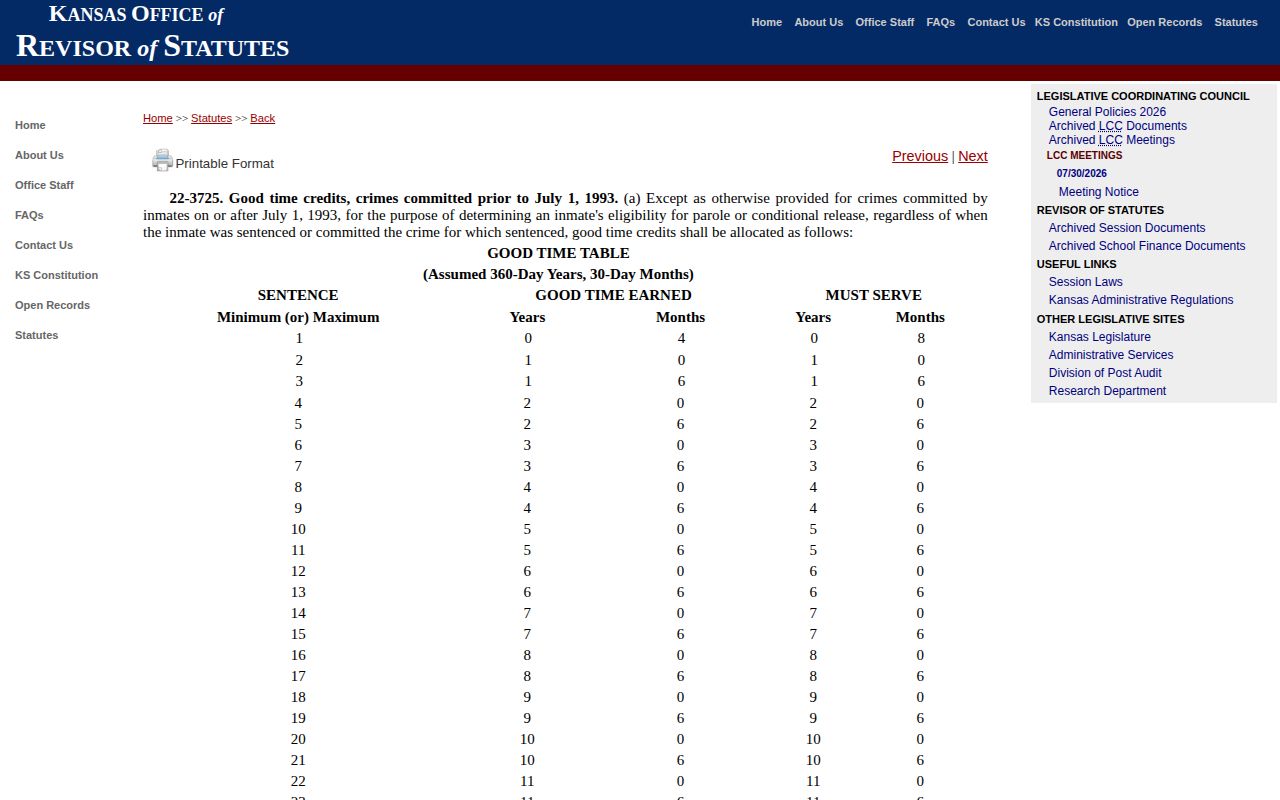
Do not combine the older provision with the guideline-era percentage. First obtain the judgment and offense date. Then ask KDOC which legal framework governs the displayed date. A parole-eligible date for an older indeterminate sentence identifies a point at which a decision may be considered. It is not a promise of release.
Ness County Parole Eligibility Dates
K.S.A. 22-3717 contains Kansas parole eligibility, conditional-release, and postrelease provisions. It is lengthy because rules vary by offense and date. A useful reading must keep eligibility, a scheduled hearing, a Board decision, and physical release separate.
The statute is the official source for those sentence-specific milestones.
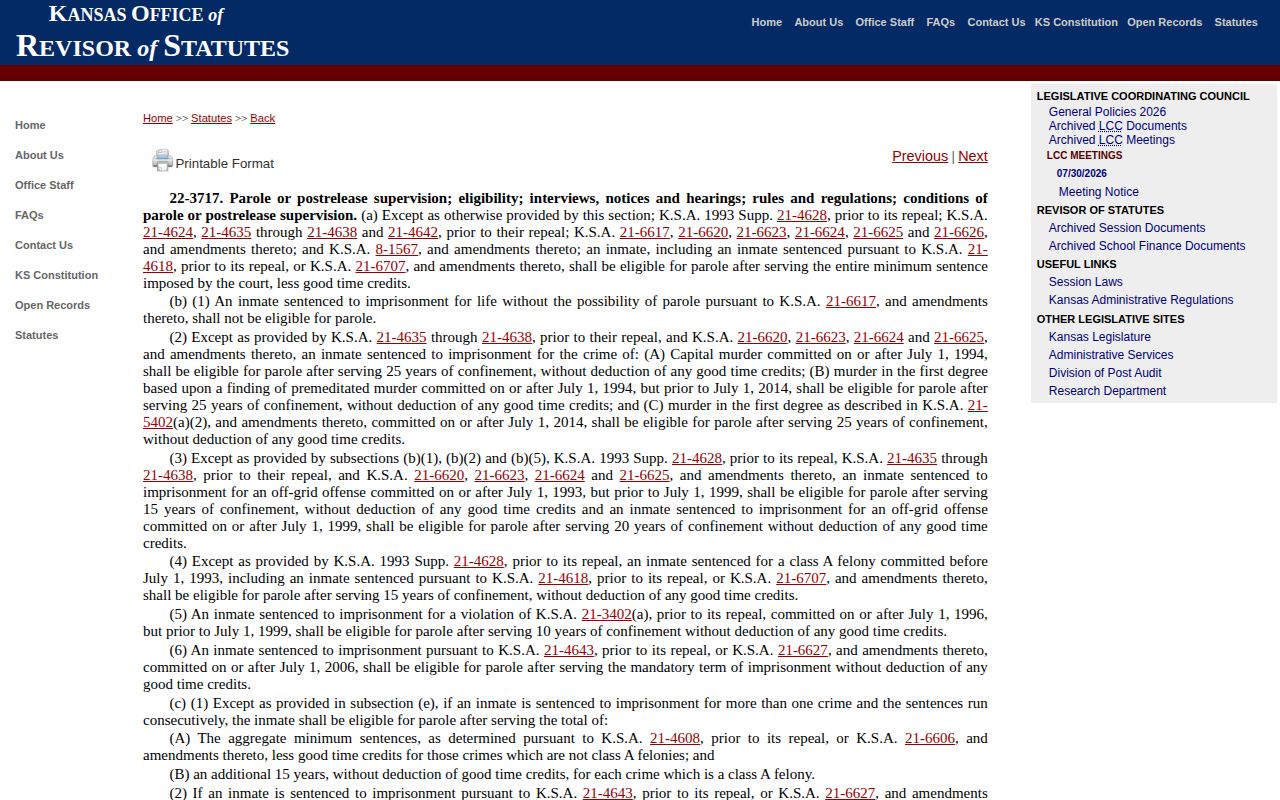
A favorable parole action can precede release planning. An approved plan, another hold, or a later Board action may still affect departure. Likewise, conditional release is a legal milestone for applicable cases, while parole is discretionary release for an eligible indeterminate sentence. KDOC’s displayed terminology and explanation should control.
The separate Ness County parole and probation guide explains how to verify the supervising office and distinguish hearing steps from final discharge.
Ness County Release Date Changes
A calculated date can move, and an unchanged date may still lead to a transfer instead of community release. The underlying factor should be verified with the office that maintains it.
| Factor | Possible effect | Where to verify |
|---|---|---|
| Jail or prison credit | Changes time credited toward the sentence | Court order, Sheriff, or KDOC |
| Earned credit or forfeiture | Moves a KDOC calculated milestone within the governing rules | KDOC and K.S.A. 21-6821 |
| Program credit | May affect an eligible sentence under separate limits | KDOC |
| Sentence modification | Changes the controlling judgment or term | Sentencing court |
| Consecutive or concurrent terms | Changes how multiple terms combine | Court judgment and KDOC |
| Parole action | Creates or delays a possible supervised release | Prisoner Review Board and KDOC |
| Detainer or another case | May cause continued custody or transfer after one term ends | Current and receiving agencies |
| New court order | May alter the authority or timing for release | Issuing court and custodian |
A date passing without a confirmed departure is a reason to call the current custodian. It is not proof that the person left, and it does not by itself show an improper hold. Ask whether the date was recalculated, another case applies, or custody passed to another agency.
When two dates appear, do not choose the earlier one without context. One may mark eligibility, another may mark a conditional point, and a third may mark the end of the sentence. Write down each full label and the status shown beside it. Then compare those fields with the judgment and any later court entry. This method keeps a Ness County projected release inquiry tied to the records that actually govern the person.
Confirm Ness County Release Dates
Use every channel according to its scope. Online, KASPER serves a state sentence and the Kansas court docket supplies the judgment. By telephone, KDOC can explain its displayed date and current calculation. The Ness County Sheriff and court can address a local sentence, jail credit, court action, and known holds. In writing, request the specific release or transfer record when a documentary answer is needed.
VINE cannot calculate time. Its role is to alert users when custody status changes on a participating-agency record. Registration availability and local coverage must be checked on the exact person’s live record. After an alert, confirm the event with KDOC, the Sheriff, or the other named holder.
For direct state questions, KDOC’s general office is at 714 SW Jackson, Suite 300, Topeka, KS 66603, and its main telephone is 785-296-3317. The official contacts page lists the Records Division at 785-746-7470. A narrow request can seek the actual release or discharge date, release mechanism, last institution, and current supervision or final-discharge status. Ask the Ness County Sheriff at 785-798-3611 about a local jail calculation or transfer. The District Court at 785-798-3693 is the source for the sentence and later court orders. Confirm public hours before visiting either local office.
Finally, classify the outcome. Release from Ness County Jail can mean direct discharge or transfer. A KDOC date concerns state custody. A federal date belongs to the Bureau of Prisons system, and an ICE locator result concerns immigration custody. One system’s date should never be relabeled as a Ness County jail release date merely because the underlying case has a county connection.
Note: The best confirmation pairs the sentence source with the custodian’s dated record of actual release or transfer.